Friday, February 19, 2010

AGW Skeptic Arguments and What the Science Says

http://www.skepticalscience.com/argument.php

Here is a summary of what the science says on each skeptic argument. You can also view the arguments sorted by taxonomy.
Skeptic Argument vs What the Science Says
1 "It's the sun" In the last 35 years of global warming, the sun has shown a slight cooling trend. Sun and climate have been going in opposite directions.
2 "Climate's changed before" Natural climate change in the past proves that climate is sensitive to an energy imbalance. If the planet accumulates heat, global temperatures will go up. Currently, CO2 is imposing an energy imbalance due to the enhanced greenhouse effect. Past climate change actually provides evidence for our climate's sensitivity to CO2.
3 "There is no consensus" That humans are causing global warming is the position of the Academies of Science from 19 countries plus many scientific organisations that study climate science. More specifically, 97% of climate scientists actively publishing climate papers endorse the consensus position.
4 "It's cooling" Empirical measurements of the Earth's heat content show the planet is still accumulating heat and global warming is still happening. Surface temperatures can show short term cooling when heat is exchanged between the atmosphere and the ocean, which has a much greater heat capacity than the air.
5 "Models are unreliable" While there are uncertainties with climate models, they successfully reproduce the past and have made predictions that have been subsequently confirmed by observations.
6 "Temp record is unreliable" Numerous studies into the effect of urban heat island effect and microsite influences find they have negligible effect on long term trends, particularly when averaged over large regions.
7 "It hasn't warmed since 1998" The planet has continued to accumulate heat since 1998 - global warming is still happening. Nevertheless, surface temperatures show much internal variability due to heat exchange between the ocean and atmosphere. 1998 was an unusually hot year due to a strong El Nino.
8 "Ice age predicted in the 70s" 1970s ice age predictions were predominantly media based. The majority of peer reviewed research at the time predicted warming due to increasing CO2.
9 "We're heading into an ice age" The warming effect from CO2 increases greatly outstrips the influence from orbital changes or variations in solar activity even if solar levels were to drop to Maunder Minimum levels.
10 "Antarctica is gaining ice" While the interior of East Antarctica is gaining land ice, overall Antarctica is losing land ice at an accelerating rate. Antarctic sea ice is growing despite a strongly warming Southern Ocean.
11 "CO2 lags temperature" When the Earth comes out of an ice age, the warming is not initiated by CO2 but by changes in the Earth's orbit. The warming causes the oceans to give up CO2. The CO2 amplifies the warming and mixes through the atmosphere, spreading warming throughout the planet. So CO2 causes warming AND rising temperature causes CO2 rise.
12 "Global warming is good" The negative impacts of global warming on agriculture, health, economy and environment far outweigh any positives.
13 "Al Gore got it wrong" While there are minor errors in An Inconvenient Truth, the main truths presented - evidence to show mankind is causing global warming and its various impacts is consistent with peer reviewed science.
14 "It's freaking cold!" Since the mid 1970s, global temperatures have been warming at around 0.2 degrees Celsius per decade. However, weather imposes its own dramatic ups and downs over the long term trend. We expect to see record cold temperatures even during global warming. Nevertheless over the last decade, daily record high temperatures occurred twice as often as record lows. This tendency towards hotter days is expected to increase as global warming continues into the 21st Century.
15 "Hurricanes aren't linked to global warming" It is unclear whether global warming is increasing hurricane frequency but there is increasing evidence that warming increases hurricane intensity.
16 "Mars is warming" Martian climate is primarily driven by dust and albedo and there is little empirical evidence that Mars is showing long term warming.
17 "It's cosmic rays" While the link between cosmic rays and cloud cover is yet to be confirmed, more importantly, there has been no correlation between cosmic rays and global temperatures over the last 30 years of global warming.
18 "1934 - hottest year on record" 1934 is the hottest year on record in the USA which only comprises 2% of the globe. According to NASA temperature records, the hottest year on record globally is 2005.
19 "It's just a natural cycle" The 1500 year cycles, known as Dansgaard-Oeschger events, are localized to the northern hemisphere and accompanied with cooling in the southern hemisphere. In contrast, current global warming is occuring in both hemispheres and particularly throughout the world's oceans, indicating a significant energy imbalance.
20 "Sea levels aren't rising (much)" Sea levels are measured by a variety of methods that show close agreement - sediment cores, tidal gauges, satellite measurements. What they find is sea level rise has been steadily accelerating over the past century.
21 "It's Urban Heat Island effect" While urban areas are undoubtedly warmer than surrounding rural areas, this has had little to no impact on warming trends.
22 "Hockey stick is broken" Since the hockey stick paper in 1998, there have been a number of proxy studies analysing a variety of different sources including corals, stalagmites, tree rings, boreholes and ice cores. They all confirm the original hockey stick conclusion: the 20th century is the warmest in the last 1000 years and that warming was most dramatic after 1920.
23 "Arctic icemelt is a natural cycle" Arctic sea ice has been retreating over the past 30 years. The rate of retreat is accelerating and in fact is exceeding most models' forecasts.
24 "Other planets are warming" There are three fundamental flaws in the 'other planets are warming' argument. Not all planets in the solar system are warming. The sun has shown no long term trend since 1950 and in fact has shown a slight cooling trend in recent decades. There are explanations for why other planets are warming.
25 "Water vapor is the most powerful greenhouse gas" Water vapour is the most dominant greenhouse gas. Water vapour is also the dominant positive feedback in our climate system and amplifies any warming caused by changes in atmospheric CO2. This positive feedback is why climate is so sensitive to CO2 warming.
26 "Greenland was green" The Greenland ice sheet has existed for at least 400,000 years. There may have been regions of Greenland that were 'greener' than today but this was not a global phenomenon.
27 "Human CO2 is a tiny % of CO2 emissions" The CO2 that nature emits (from the ocean and vegetation) is balanced by natural absorptions (again by the ocean and vegetation). Therefore human emissions upset the natural balance, rising CO2 to levels not seen in at least 800,000 years. In fact, human emit 26 gigatonnes of CO2 per year while CO2 in the atmosphere is rising by only 15 gigatonnes per year - much of human CO2 emissions is being absorbed by natural sinks.
28 "We're coming out of an ice age" The main driver of the warming from the Little Ice Age to 1940 was the warming sun with a small contribution from volcanic activity. However, solar activity leveled off after 1940 and the net influence from sun and volcano since 1940 has been slight cooling. Greenhouse gases have been the main contributor of warming since 1970.
29 "Oceans are cooling" Early estimates of ocean heat from the Argo showed a cooling bias due to pressure sensor issues. Recent estimates of ocean heat that take this bias into account show continued warming of the upper ocean. This is confirmed by independent estimates of ocean heat as well as more comprehensive measurements of ocean heat down to 2000 metres deep.
30 "It cooled mid-century" There are a number of forcings which affect climate (eg - stratospheric aerosols, solar variations). When all forcings are combined, they show good correlation to global temperature throughout the 20th century including the mid-century cooling period. However, for the last 35 years, the dominant forcing has been CO2.
31 "It warmed before 1940 when CO2 was low" Early 20th century warming was in large part due to rising solar activity and relatively quiet volcanic activity. However, both factors have played little to no part in the warming since 1975. Solar activity has been steady since the 50's. Volcanoes have been relatively frequent and if anything, have exerted a cooling effect.
32 "Mt. Kilimanjaro's ice loss is due to land use" Mount Kilimanjaro's shrinking glacier is complicated and not due to just global warming. However, this does not mean the Earth is not warming. There is ample evidence that Earth's average temperature has increased in the past 100 years and the decline of mid- and high-latitude glaciers is a major piece of evidence.
33 "Climate sensitivity is low" Climate sensitivity can be calculated empirically by comparing past temperature change to natural forcings at the time. Various periods of Earth's past have been examined in this manner and find broad agreement of a climate sensitivity of around 3°C.
34 "There's no empirical evidence" Direct observations find that CO2 is rising sharply due to human activity. Satellite and surface measurements find less energy is escaping to space at CO2 absorption wavelengths. Ocean and surface temperature measurements find the planet continues to accumulate heat. This gives a line of empirical evidence that human CO2 emissions are causing global warming.
35 "Polar bear numbers are increasing" While there is some uncertainty on current polar bear population trends, one thing is certain. No sea ice means no seals which means no polar bears. With Arctic sea ice retreating at an accelerating rate, the polar bear is at grave risk of extinction
36 "Glaciers are growing" While there are isolated cases of growing glaciers, the overwhelming trend in glaciers worldwide is retreat. In fact, the global melt rate has been accelerating since the mid-1970s.
37 "Extreme weather isn't caused by global warming" There is growing empirical evidence that warming temperatures cause more intense hurricanes, heavier rainfalls and flooding, increased conditions for wildfires and dangerous heat waves.
38 "Satellites show no warming in the troposphere" Satellite measurements match model results apart from in the tropics. There is uncertainty with the tropic data due to how various teams correct for satellite drift. The U.S. Climate Change Science Program conclude the discrepancy is most likely due to data errors.
39 "IPCC does not represent a scientific consensus" The IPCC lead authors are experts in their field, instructed to fairly represent the full range of the up-to-date, peer-reviewed literature. Consequently, the IPCC reports tend to be cautious in their conclusions. Comparisons to the most recent data consistently finds that climate change is occurring more rapidly and intensely than indicated by IPCC predictions.
40 "CO2 effect is weak" An enhanced greenhouse effect from CO2 has been confirmed by multiple lines of empirical evidence. Satellite measurements of infrared spectra over the past 40 years observe less energy escaping to space at the wavelengths associated with CO2. Surface measurements find more downward infrared radiation warming the planet's surface. This provides a direct, empirical causal link between CO2 and global warming.
41 "CO2 is not a pollutant" While there are direct ways in which CO2 is a pollutant (acidification of the ocean), it's primary impact is its greenhouse warming effect. While the greenhouse effect is a natural occurance, too much warming has severe negative impacts on agriculture, health and environment.
42 "There's no correlation between CO2 and temperature" Even during a period of long term warming, there are short periods of cooling due to climate variability. Short term cooling over the last few years is largely due to a strong La Nina phase in the Pacific Ocean and a prolonged solar minimum.
43 "CO2 has been higher in the past" When CO2 levels were higher in the past, solar levels were also lower. The combined effect of sun and CO2 matches well with climate.
44 "Scientists can't even predict weather" Weather is chaotic, making prediction difficult. However, climate takes a long term view, averaging weather out over time. This removes the chaotic element, enabling climate models to successfully predict future climate change.
45 "Greenland is gaining ice" While the Greenland interior is in mass balance, the coastlines are losing ice. Overall Greenland is losing ice mass at an accelerating rate. From 2002 to 2009, the rate of ice mass loss doubled.
46 "Neptune is warming" Neptune's orbit is 164 years so observations (1950 to present day) span less than a third of a Neptunian year. Climate modelling of Neptune suggests its brightening is a seasonal response. Eg - Neptune's southern hemisphere is heading into summer.
47 "Jupiter is warming" Jupiter's climate change is due to shifts in internal turbulence fueled from an internal heat source - the planet radiates twice as much energy as it receives from the sun.
48 "CRU emails suggest climate conspiracy" While some of the private correspondance is not commendable, an informed examination of their "suggestive" emails reveal technical discussions using techniques well known in the peer reviewed literature. Focusing on a few suggestive emails merely serves to distract from the wealth of empirical evidence for man-made global warming.
49 "There's no tropospheric hot spot" Satellite measurements match model results apart from in the tropics. There is uncertainty with the tropic data due to how various teams correct for satellite drift. The U.S. Climate Change Science Program conclude the discrepancy is most likely due to data errors.
50 "Pluto is warming" Pluto's climate change over the last 14 years is likely a seasonal event. Pluto experiences drastic season changes due to an elliptical orbit (that takes 250 Earth years). Any Plutonian warming cannot be caused by solar variations as the sun has showed little to no long term trend over the past 50 years and sunlight at Pluto is 900 times weaker than it is at the Earth.
51 "It's Pacific Decadal Oscillation" PDO as an oscillation between positive and negative values shows no long term trend, while temperature shows a long term warming trend. When the PDO last switched to a cool phase, global temperatures were about 0.4C cooler than currently. The long term warming trend indicates the total energy in the Earth's climate system is increasing due to an energy imbalance.
52 "Greenland ice sheet is stable" Satellite gravity measurements show Greenland is losing ice mass at an accelerated rate, increasing its contribution to rising sea levels.
53 "It's the ocean" Oceans are warming across the globe. In fact, globally oceans are accumulating energy at a rate of 4 x 10²¹ Joules per year - equivalent to 127,000 nuclear plants (which have an average output of 1 gigawatt) pouring their energy directly into the world's oceans. This tells us the planet is in energy imbalance - more energy is coming in than radiating back out to space.
54 "The CO2 effect is saturated" If the CO2 effect was saturated, adding more CO2 should add no additional greenhouse effect. However, satellite and surface measurements observe an enhanced greenhouse effect at the wavelengths that CO2 absorb energy. This is empirical proof that the CO2 effect is not saturated.
55 "Animals and plants can adapt to global warming" A large number of ancient mass extinction events have been strongly linked to global climate change. Because current climate change is so rapid, the way species typically adapt (eg - migration) is, in most cases, simply not be possible. Global change is simply too pervasive and occurring too rapidly.
56 "Volcanoes emit more CO2 than humans" Volcanoes emit around 0.3 billion tonnes of CO2 per year. This is about 1% of human CO2 emissions which is around 29 billion tonnes per year.
57 "Less than half of published scientists endorse global warming" Schulte's paper makes much of the fact that 48% of the papers they surveyed are neutral papers, refusing to either accept or reject anthropogenic global warming. The fact that so many studies on climate change don't bother to endorse the consensus position is significant because scientists have largely moved from what's causing global warming onto discussing details of the problem (eg - how fast, how soon, impacts, etc).
58 "CO2 measurements are suspect" CO2 levels are measured by hundreds of stations scattered across 66 countries which all report the same rising trend.
59 "It's aerosols" The global dimming trend reversed around 1990 - 15 years after the global warming trend began in the mid 1970's.
60 "It's El NiƱo" The El Nino Southern Oscillation shows close correlation to global temperatures over the short term. However, it is unable to explain the long term warming trend over the past few decades.
61 "It's a climate regime shift" A full reading of Tsonis and Swanson's research shows that internal variability from climate shifts merely cause temporary slow downs or speeding up of the long-term warming trend. When the internal variability is removed from the temperature record, what we find is nearly monotonic, accelerating warming throughout the 20th Century.
62 "Humans are too insignificant to affect global climate" Atmospheric CO2 levels are rising by 15 gigatonnes per year. Humans are emitting 26 gigatonnes of CO2 into the atmosphere. Humans are dramatically altering the composition of our climate.
63 "It's land use" Correlations between warming and economic activity are most likely spurious. They don't take into account local forcing agents such as tropospheric ozone or black carbon. Correlations are likely over-estimated since grid boxes in both economic and climate data are not independent. Lastly, there is significant independent evidence for warming in the oceans, snow cover and sea ice extent changes.
64 "It's microsite influences" Data analysis comparing the temperature trends from poorly sited weather stations to well sited stations find the poor sites actually show a cooling bias compared to good sites. The cooling bias is caused by a change to the Maximum/Minimum Temperature Systems which is found more often at poor sites. When the change of instrument biases are taken into account, there is very little difference between the trends from poor and well sited weather stations.
65 "It's methane" While methane is a more potent greenhouse gas than CO2, there is over 200 times more CO2 in the atmosphere. Hence the amount of warming methane contributes is 28% of the warming CO2 contributes.
66 "Medieval Warm Period was warmer" While the Medieval Warm Period saw unusually warm temperatures in some regions, globally the planet was cooler than current conditions.
67 "Solar Cycle Length proves its the sun" The claim that solar cycle length proves the sun is driving global warming is based on a single study published in 1991. Subsequent research, including a paper by a co-author of the original 1991 paper, finds the opposite conclusion. Solar cycle length as a proxy for solar activity tells us the sun has had very little contribution to global warming since 1975.
68 "Naomi Oreskes' study on consensus was flawed" An examination of the papers that critics claim refute the consensus are found to actually endorse the consensus or are review papers (eg - they don't offer any new research but merely review other papers). This led the original critic Benny Peisner to retract his criticism of Oreskes' study.
69 "Water levels correlate with sunspots" There seems to be evidence for a link between solar activity and water levels. However, more direct comparisons between solar activity and global temperature finds that as the sun grew hotter or cooler, Earth's climate followed it with a 10 year lag - presumably due to the dampening effect of the ocean. Also found was that the correlation between solar activity and global temperatures ended around 1975, hence recent warming must have some other cause than solar variations.
70 "Solar cycles cause global warming" A full reading of Tung 2008 finds a distinct 11 year solar signal in the global temperature record. However, this 11 year cycle is superimposed over the long term global warming trend. In fact, the authors go on to estimate climate sensitivity from their findings, calculate a value between 2.3 to 4.1°C. This confirms the IPCC estimate of climate sensitivity.
71 "The sun is getting hotter" Various independent measurements of solar activity all confirm the sun has shown a slight cooling trend since 1978.
72 "IPCC were wrong about Himalayan glaciers" The IPCC error on the 2035 prediction was unfortunate and it's important that such mistakes are avoided in future publications through more rigorous review. But the central message of the IPCC AR4, is confirmed by the peer reviewed literature. The Himalayan glaciers are of vital importance, providing drinking water to half a billion people. Satellites and on-site measurements are observing that Himalayan glaciers are disappearing at an accelerating rate.
73 "It's albedo" The long term trend from albedo is that of cooling. In recent years, satellite measurements of albedo show little to no trend.
74 "Water vapor in the stratosphere stopped global warming" The effect from stratospheric water vapor contributes a fraction of the temperature change imposed from man-made greenhouse gases. Also, it's not yet clear whether changes in stratospheric water vapor are caused by a climate feedback or internal variability (eg - linked to El Nino Southern Oscillation). However, the long term warming trend seems to speak against the possibility of a negative feedback.
75 "Phil Jones says no global warming since 1995" When you read Phil Jones' actual words, you see he's saying there is a warming trend but it's not statistically significant. He's not talking about whether warming is actually happening. He's discussing our ability to detect that warming trend in a noisy signal over a short period.
76 "CO2 is not the only driver of climate" While there are many drivers of climate, CO2 is the most dominant radiative forcing and is increasing faster than any other forcing.
77 "Sea level rise predictions are exaggerated" Observed sea levels are actually tracking at the upper range of the IPCC projections. When accelerating ice loss from Greenland and Antarctica are factored into sea level projections, the estimated sea level rise by 2100 is between 75cm to 2 metres.
78 "December 2009 saw record cold spells" The cold snap is due to a strong phase of the Arctic Oscillation. This is causing cool temperatures at mid-latitudes (eg - Eurasia and North America) and warming in polar regions (Greenland and Arctic Ocean). The warm and cool regions roughly balance each other out with little impact on global temperature.
79 "It's not happening" There are many lines of independent empirical evidence for global warming, from accelerated ice loss from the Arctic to Antarctica to the inexorable poleward migration of plant and animal species across the globe.
80 "Trenberth can't account for the lack of warming" Trenberth's views are clarified in the paper "An imperative for climate change planning: tracking Earth's global energy". We know the planet is continually heating due to increasing carbon dioxide but that surface temperature sometimes have short term cooling periods. This is due to internal variability and Trenberth was lamenting that our observation systems can't comprehensively track all the energy flow through the climate system.
81 "It's CFCs" Models and direct observations find that CFCs only contribute a fraction of the warming supplied by other greenhouse gases.
82 "CO2 is not increasing" Currently, humans are emitting around 29 billion tonnes of carbon dioxide into the atmosphere per year. Around 43% remains in the atmosphere - this is called the 'airborne fraction'. The rest is absorbed by vegetation and the oceans. While there are questions over how much the airborne fraction is increasing, it is clear that the total amount of CO2 in the atmosphere is increasing dramatically. Current CO2 levels are the highest in 15 million years.
83 "Climate is chaotic and cannot be predicted" Weather is chaotic because air is light, it has low friction and viscosity, it expands strongly when in contact with hot surfaces and it conducts heat poorly. Therefore weather is never in equilibrium and the wind always blows. The climate is mostly explained by equilibrium radiation physics, which puts the brakes on variations in global temperatures. Effects from weather, the Sun, volcanoes etc. currently only causes a small amount of chaotic behavior compared to the deterministic, predictable greenhouse gas forcing for the next 100 years"
84 "It's ozone" Multiple satellite measurements and ground-based observations have determined the ozone layer has stopped declining since 1995 while temperature trends continue upwards.
85 "It's satellite microwave transmissions" A generous estimate of the energy generated by satellites is around 1 million times too small to cause global warming.
86 "Global temperatures dropped sharply in 2007" 2007's dramatic cooling is driven by strong La Nina conditions which historically has caused similar drops in global temperature. It is also exacerbated by unusually low solar activity.
87 "Ice isn't melting" Ice mass loss is occuring at an accelerated rate in Greenland, Antarctica and globally from inland glaciers. Arctic sea ice is also falling at an accelerated rate. The exception to this ice loss is Antarctic sea ice which has been growing despite the warming Southern Ocean. This is due to local factors unique to the area.
88 "Tree-rings diverge from temperature after 1960" The divergence problem is a physical phenomenon - tree growth has slowed or declined in the last few decades, mostly in high northern latitudes. The divergence problem is unprecedented, unique to the last few decades, indicating its cause may be anthropogenic. The cause is likely to be a combination of local and global factors such as warming-induced drought and global dimming. Tree-ring proxy reconstructions are reliable before 1960, tracking closely with the instrumental record and other independent proxies.
89 "A drop in volcanic activity caused warming" A drop of volcanic activity in the early 20th century may have had a warming effect. However, volcanoes have had no warming effect in the last 40 years of global warming. If anything, they've imposed a slight cooling effect.
90 "IPCC were wrong about Amazon rainforests" The IPCC statement on Amazon rain forests is correct. The error was incorrect citation, failing to mention the peer-reviewed papers where the data came from. The peer-reviewed science prior to the 2007 IPCC report found that up to 40% of the Brazilian forest is vulnerable to drought. Subsequent field research has confirmed this assessment.
91 "We didn't have global warming during the Industrial Revolution" Global CO2 emissions during the Industrial Revolution were a fraction of the CO2 we are currently emitting now.
© Copyright 2010 John Cook

...


"The era of procrastination, of half-measures, of soothing and baffling expedients, of delays, is coming to a close. In its place, we are entering a period of consequences." - Winston Churchill, The Gathering Storm

Saturday, February 13, 2010

Republicans and Medicare -Krugman

Op-Ed Columnist - Republicans and Medicare - NYTimes.com
Published: February 11, 2010

“Don’t cut Medicare. The reform bills passed by the House and Senate cut Medicare by approximately $500 billion. This is wrong.” So declared Newt Gingrich, the former speaker of the House, in a recent op-ed article written with John Goodman, the president of the National Center for Policy Analysis.

And irony died.

Now, Mr. Gingrich was just repeating the current party line. Furious denunciations of any effort to seek cost savings in Medicare — death panels! — have been central to Republican efforts to demonize health reform. What’s amazing, however, is that they’re getting away with it.

Why is this amazing? It’s not just the fact that Republicans are now posing as staunch defenders of a program they have hated ever since the days when Ronald Reagan warned that Medicare would destroy America’s freedom. Nor is it even the fact that, as House speaker, Mr. Gingrich personally tried to ram through deep cuts in Medicare — and, in 1995, went so far as to shut down the federal government in an attempt to bully Bill Clinton into accepting those cuts.

After all, you could explain this about-face by supposing that Republicans have had a change of heart, that they have finally realized just how much good Medicare does. And if you believe that, I’ve got some mortgage-backed securities you might want to buy.

No, what’s truly mind-boggling is this: Even as Republicans denounce modest proposals to rein in Medicare’s rising costs, they are, themselves, seeking to dismantle the whole program. And the process of dismantling would begin with spending cuts of about $650 billion over the next decade. Math is hard, but I do believe that’s more than the roughly $400 billion (not $500 billion) in Medicare savings projected for the Democratic health bills.

What I’m talking about here is the “Roadmap for America’s Future,” the budget plan recently released by Representative Paul Ryan, the ranking Republican member of the House Budget Committee. Other leading Republicans have been bobbing and weaving on the official status of this proposal, but it’s pretty clear that Mr. Ryan’s vision does, in fact, represent what the G.O.P. would try to do if it returns to power.

The broad picture that emerges from the “roadmap” is of an economic agenda that hasn’t changed one iota in response to the economic failures of the Bush years. In particular, Mr. Ryan offers a plan for Social Security privatization that is basically identical to the Bush proposals of five years ago.

But what’s really worth noting, given the way the G.O.P. has campaigned against health care reform, is what Mr. Ryan proposes doing with and to Medicare.

In the Ryan proposal, nobody currently under the age of 55 would be covered by Medicare as it now exists. Instead, people would receive vouchers and be told to buy their own insurance. And even this new, privatized version of Medicare would erode over time because the value of these vouchers would almost surely lag ever further behind the actual cost of health insurance. By the time Americans now in their 20s or 30s reached the age of eligibility, there wouldn’t be much of a Medicare program left.

But what about those who already are covered by Medicare, or will enter the program over the next decade? You’re safe, says the roadmap; you’ll still be eligible for traditional Medicare. Except, that is, for the fact that the plan “strengthens the current program with changes such as income-relating drug benefit premiums to ensure long-term sustainability.”

If this sounds like deliberately confusing gobbledygook, that’s because it is. Fortunately, the Congressional Budget Office, which has done an evaluation of the roadmap, offers a translation: “Some higher-income enrollees would pay higher premiums, and some program payments would be reduced.” In short, there would be Medicare cuts.

And it’s possible to back out the size of those cuts from the budget office analysis, which compares the Ryan proposal with a “baseline” representing current policy. As I’ve already said, the total over the next decade comes to about $650 billion — substantially bigger than the Medicare savings in the Democratic bills.

The bottom line, then, is that the crusade against health reform has relied, crucially, on utter hypocrisy: Republicans who hate Medicare, tried to slash Medicare in the past, and still aim to dismantle the program over time, have been scoring political points by denouncing proposals for modest cost savings — savings that are substantially smaller than the spending cuts buried in their own proposals.

And if Democrats don’t get their act together and push the almost-completed reform across the goal line, this breathtaking act of staggering hypocrisy will succeed.


Sunday, January 03, 2010

Letter from Army major in Iraq

Roy Speaks of Bakersfield, an Army major stationed in Iraq, wrote the following letter to a friend about the stresses of serving in that country. He granted us permission to share it with our readers.

Carl,

I was reading one of the many articles about how the Army is trying to figure a way to decrease the occurrence of post traumatic stress and thought of that conversation we had a couple years ago.

It is an unfortunate reality that a person who has not experienced it will never know.

I have changed. I can't talk to my wife about it, and there may be something in our conversation that may help someone in the future, so here goes.

Upon arrival your life significantly changes just by sight. Walking through the area is like walking through a maze. Fourteen-foot concrete blast walls are everywhere. The living area is symmetrically lined up and is probably two miles square. Since I am a major I share a room with another major.

The trailer itself is called a CHU -- Containerized Housing Unit. It has one door, one window, and an air conditioner. Keep in mind that your CHU is surrounded by 14-foot blast walls. They are inherently dirty.

Everything is dirty because of the dust in the summer and the mud in the winter. The walls may or may not have years of smoke film on them, not from cigarettes but from the burning trash pits and occasional fires.

Sounds like a prison cell doesn't it? Actually I can say that I believe prisoners have better conditions. At least they have a toilet in their room. I have to walk 30 yards to a porta-john and 200 yards if I want to get to a trailer. You learn to use water bottles in the middle of the night.

Food is served by third country nationals, usually Pakistani or Indian, and it is just a big room.

The food isn't bad, but you eat at the same time every day and always the same things on the menu. Sound like prison?

You go to work, you eat, work, back to the CHU and sleep. There is TV if you buy it or bring it that plays Armed Forces Network programming.

OK, that sets the stage.

Each morning I sit in on an update to the commander. The brief consists of when, where, and how attacks occurred and of course how many US KIA (killed in action) and WIA (wounded in action).

It talks continuously about how we are helping the Iraqis to secure themselves from themselves. Is that crazy or what? I always look and see that the locations of the attacks. Sometimes they occur where I have been, on occasion as recently as the day prior. I think every time that it could have been me. At the end the chaplain picks one of the U.S. service members who has been killed in the last week and does what they call a soldier tribute. We stand and listen to where he lived, what he did growing up and who he left behind. Kids, wife, mom, dad -- it all sucks because everyone leaves someone else behind. It could have been me.

At night you may be sitting in your CHU reading when the alarm sounds for incoming. You can do nothing other than hope it does not land on your CHU. You hear the explosion and try and guess how far away it was -- 1/2 mile, 1000 yards, or 100 feet? You wonder where the next one will hit and if it will hit your CHU.

Typically on those nights I do not sleep real well.

The first thing you do after the attack is head for accountability. Did it hit a friend or co-worker's CHU? Who is dead?

The next day you read the report, it landed by the chow hall; 10 wounded, 2 killed. It landed on someone's CHU. He died reading a book. It could have been me.

My job is to develop plans to "assist the Iraqi government to establish a secure and stable Iraq." They don't even help themselves. My experience is that they are ungrateful, they want, want, want.

When it is convenient they claim religious rights, when it is not convenient, they do not abide.

My view of the Arab culture has changed significantly. My views on Islam have changed significantly. And unfortunately my view on Muslims overall has changed and in particular in America.

I am angry, sad, disappointed, and scared. It could be me next. Wrong place, wrong time by coincidence and it could be me, Carl.

Means I don't get to go home. I don't get to hold Kadie or play with Mason.

It could be me, Carl. Carry that around each and every day for 12 -15 months and imagine how that effects your psyche when you return to freedom.

I can easily see a kid having too much to drink, too much anger, getting over being scared s------- every night for 12 months. He is in the wrong place at the wrong time and circumstances trigger something. An inner thought or feeling and he makes a mistake.

Bang, no representation or representation that can't understand. Representation that wants to understand but just can't. It is impossible unless you have lived it. There is no jury of peers, only a jury of people that don't understand. A judge that doesn't understand.

I am not excusing criminal behavior, merely using it as an example. I could have used employment to prove a point.

I am praying that when I get home I can sleep, the edge comes off, the anger goes away and the old Roy comes back but I don't know.

I can tell you that regardless of the adjustment and re-integration there are feelings that will never change. This experience changes all of us whether they admit it or not.

OK, how is that for a rambling story? Thanks for listening and I look forward to the dialogue. I think it helps me to talk about it.

It's now 295 days down and 75 remaining. I can see the light at the end of the tunnel but I am not sure where it leads. I do not for one second regret my service to my country nor do I regret my most recent deployment. I have learned so many things, met great people, and influenced the Iraqi conflict on behalf of the American citizens.

The difficulty of being separated from your family, however, is immeasurable.

Surrounded by so many, but have never felt so alone.


Tuesday, December 22, 2009

Five Critical Flaws in the Senate Health Care Bill

The Senate bill would:

#1—Deny Americans the choice of a public option. In contrast, the House bill contains a national public option, the key to real competition, greater choice, and lower costs.

#2—Leave insurance unaffordable for some lower income and working people. Both bills require virtually all Americans to buy insurance. But even with the subsidies provided, some families could have to pay up to 20% of their income on health care expenses.

#3—Impose dangerous restrictions on women's reproductive health care. Unfortunately, both bills do this and the House provision is worse. Both versions would be a dangerous step and neither should be in the final bill.

#4—Tax American workers' health coverage to pay for reform. The Senate would pay for part of reform by taxing the hard-won benefits packages of many working Americans. The House, on the other hand, pays for reform with a small surcharge on only the wealthiest Americans—a far better approach.

#5—Allow insurance companies to remain exempt from anti-trust laws. Under current law, insurance companies are actually exempt from laws designed to prevent monopolies and price-gouging. The House bill would fix this, but the Senate bill leaves it in place.
...


"The era of procrastination, of half-measures, of soothing and baffling expedients, of delays, is coming to a close. In its place, we are entering a period of consequences." - Winston Churchill, The Gathering Storm

Monday, December 07, 2009

I wonder what Ben Stein would say now

From 2007...

In an excellent piece in the New York Times, entitled It's Time to Take a Deep Breadth, Stein outlines the issues, the stresses, and the realities of the market volatility and corrections underway. He does not run from or white wash the credit disaster and the real estate crash underway, but he brings perspective and calm to his analyses. He is a voice otherwise missing at this time in the markets, in government, and in the media. Let me quote briefly from his article, near the end of his piece and after he says “I get to the point of laughing when I read doom-saying articles in the business sections of newspapers or watch Jim Cramer on CNBC.":

"Yes, there are real problems: housing, mortgage defaults, losses at financial firms, rot in hedge funds. But over all, things will be fine.... This economy is very big and very solid. It cannot be derailed for long by anything we have seen lately.... If I were the editor of the business section for just one day, I would run one immense headline: Everything in Going to Be Fine. Go Back to Work."

http://www.nytimes.com/2007/09/09/business/09every.html?ref=todayspaper

...


"The era of procrastination, of half-measures, of soothing and baffling expedients, of delays, is coming to a close. In its place, we are entering a period of consequences." - Winston Churchill, The Gathering Storm

Negative stimulus on its way

estimates for budget shortfalls at the state level come to $145 billion to $178 billion in the fiscal year that ends next June. Budget gaps like that, on top of already drastic spending cuts in 2008 and 2009, will produce deep cutbacks in spending on everything from road and school construction to employment of police, firefighters, teachers and state park workers. The same survey that showed 44% of contractors anticipating more layoffs also showed that 76% expect state transportation departments to put less work out for bid in 2010 than in 2009.
...


"The era of procrastination, of half-measures, of soothing and baffling expedients, of delays, is coming to a close. In its place, we are entering a period of consequences." - Winston Churchill, The Gathering Storm

Wednesday, November 18, 2009

Look out! We're gonna crash! (again)

Why the Stock Market Should Crash -- Seeking Alpha

I'm not saying the stock market will crash, only that if it had any relation to the real U.S. economy that it should crash, and soon.

The current politics of experience is so warped by misleading statistics and orchestrated propaganda that it feels strange to state the obvious and find it is "that which cannot be spoken" -- the credit-dependent, consumer-dependent U.S. economy is going down, and going down hard, and the trillions of dollars borrowed and spent by the U.S. government and Federal Reserve to crank up a recovery have failed completely, utterly and totally.

The basic idea of Keynesian policy is simple: when the wheels fall off the private, quasi-free enterprise economy the government borrows and spreads mountains of money around like fertilizer which will stimulate "green shoots" of recovery.

The forgotten key to successful Keynesian policy is a government which has not been borrowing and spending trillions of dollars even during an era of so-called "prosperity." When a government like that of the U.S. has been propping up "prosperity" with trillions in borrowed money for a decade, then doubling or tripling the "stimulus" in the hopes that the green shoots will be enduring is truly farcical.

If the economy needed several trillion dollars in deficit spending to eke out the meager jobless growth of 2001-2007, then why does anyone think that doubling or tripling that deficit spending will create an enduring boom?

The truth is the U.S. economy has been dependent on Federal stimulus for years, both the indirect stimulus of artificially low interest rates and unlimited liquidity, and the direct spending of hundreds of billions of borrowed dollars.

Even before the financial crisis, the Federal government was borrowing and spending $400 billion a year to prop up "prosperity." All that spending simply papered over the rot at the core of the economy:

1. The primary support of the U.S. economy is consumer spending which is ultimately based on household income and assets.

Earned income has been flat to down for most Americans for years. The median income has been skewed upward by the top 10% whose earnings have risen significantly. According to the Bureau of Economic Analysis, real disposable personal income-- income adjusted for inflation and taxes--declined 3.4% in the third quarter after increasing 3.8% in the second quarter.

In an economy dependent on consumer spending for 70% of GDP, how can GDP rise by 3.5% while personal income plummeted by 3.4%? Assuming that boost in GDP is real and not just statistical legerdemain, then where did it come from? From borrowed money, of course-- the Federal government borrowed and spent over $1.4 trillion in fiscal 2009.

In the good old days of 2002-2007, households would have borrowed and spent hundreds of billions as well. But the consumer, beset by declining assets ($13 trillion lost in the past two years), declining income (see above), falling housing values and worrisome employment trends (17% unemployment/underemployment, broadly measured), is actually cutting back on borrowing. (Revolving Consumer Credit Drops 13.1% in August.)

Consumer credit decreased at an annual rate of 5-3/4% in August 2009. Revolving credit (credit cards) decreased at an annual rate of 13%, and nonrevolving credit decreased at an annual rate of 1-1/2% --the longest decline in consumer debt since 1991.

So while households are still burdened with almost $2.5 trillion in credit card and nonrevolving debt (auto loans, etc.), they are paying debt down, not adding more.

And let's not forget that homeowners pulled out about $5 trillion in home equity in 2001-2007, and the home equity ATM is closed for good. That brings us to:

2. The primary asset in most U.S. households is a home, and home values are still dropping, foreclosures are still rising and the only force keeping the market from falling faster is the Federal government's de facto nationalization of the entire U.S. mortgage market.

Of the $1.5 trillion mortgage securities issued in 2009, a mere 1% ($15 billion) have been issued by banks; 99% are backed by the government. The government owns over half the nation's $10 trillion in mortgages via its de facto ownership of Fannie Mae (FNM) and Freddie Mac (FRE), and it has guaranteed virtually all the mortgages originated in the past year via FHA or VA.

The residential mortgage market is now effectively owned lock, stock and barrel by the Federal government and its private "central bank," the Federal Reserve.

Should the Fed and Treasury reduce their subsidies (that wonderful $8,000 giveaway tax credit to new home buyers or anyone claiming to be one), guarantees and outright purchases of mortgages ($1.2 trillion this year alone), then the mortgage market would instantly freeze up or start pricing in the very real risk that housing is not "recovering" and that anyone holding a mortgage could suffer huge losses if real estate continues declining in value.

Here are a few charts to ponder:


3. So how have companies "surprised" with higher profits? By slashing payrolls, R&D and various accounting tricks. Actual revenue growth is missing in action. So how do you keep "surprising to the upside" after you've slashed headcount, burned R&D and turned every accounting trick in the book?

You don't. A stock market rising on the hopes of an actual, real, tangible recovery in household income, home equity and creditworthiness is seeing mirages and hallucinating that the lake just ahead is deep and wonderful and stretches to the horizon.

Only we never reach the "lake," do we? "Stabilization" is a chimera; the reality is the government is propping up the economy via unprecedented borrowing and spending, and there is absolutely no evidence that private capital, credit or spending are rising from the "stabilization."

We are walking through the desert, kept alive by the sugar-water drip of Federal stimulus, guarantees and subsidies. The "so near, yet so far" mirage of "recovery" has been propping up the stock market for nine months, and when a slight breeze blows away the thermal illusion, then the market will crash back to the March lows, or perhaps even lower. That crash will simply reflect the state of the real economy.


...


"The era of procrastination, of half-measures, of soothing and baffling expedients, of delays, is coming to a close. In its place, we are entering a period of consequences." - Winston Churchill, The Gathering Storm
Thursday, September 17, 2009

Schaeffer's Open Letter to the Republican Traitors

Frank Schaeffer: Open Letter to the Republican Traitors (From a Former Republican)
You Republicans are the arsonists who burned down our national home. You combined the failed ideologies of the Religious Right, so-called free market deregulation and the Neoconservative love of war to light a fire that has consumed America. Now you have the nerve to criticize the "architect" America just hired -- President Obama -- to rebuild from the ashes. You do nothing constructive, just try to hinder the one person willing and able to fix the mess you created.

I used to be one of you. As recently as 2000 I worked to get Senator McCain elected in that year's primary. (McCain and Gen. Tommy Franks wrote glowing endorsements regarding my book about military service, AWOL.). I have a file of handwritten thank you notes from Presidents Ford, Reagan, Bush I and II. In the 1970s and early 80s I hung out with Jack Kemp and bought into his "supply side" myth and even wrote a book he endorsed pushing his ideas.) There's more, but take it from me; my parents (evangelical leaders Francis and Edith Schaeffer) and I were about as tight with -- and useful to -- the Republican Party as anyone. We played a big part creating the Religious Right.

In the mid 1980s I left the Religious Right, after I realized just how very anti-American they are, (the theme I explore in my book Crazy For God). They wanted America to fail in order to prove they were right about America's "moral decline." Soon after McCain lost in 2000 I re-registered as an independent in disgust with W. Bush. But I still respected many Republicans. Not today.

How can anyone who loves our country support the Republicans now? Barry Goldwater, William F. Buckley and Ronald Reagan defined the modern conservatism that used to be what the Republican Party I belonged to was about. Today no actual conservative can be a Republican. Reagan would despise today's wholly negative Republican Party. And can you picture the gentlemanly and always polite Ronald Reagan, endorsing a radio hate-jock slob who crudely mocked a man with Parkinson's and who now says he wants an American president to fail?!

With people like Limbaugh as the loudmouth image of the Republican Party -- you need no enemies. But something far more serious has happened than an image problem: the Republican Party has become the party of obstruction at just the time when all Americans should be pulling together for the good of our country. Instead, Republicans are today's fifth column sabotaging American renewal.

President Obama has been in office barely 45 days and the Republican Party has the nerve to blame him for the economic and military cataclysm he inherited. I say economic and military cataclysm because without the needless war in Iraq you all backed we would not be in the economic mess we're in today. If that money had been spent here at home on renovating our infrastructure, taking us toward a green economy, putting our health-care system in order we'd be a very different situation.

As the father of a Marine who served in George W. Bush's misbegotten wars let me say this: if President Obama's strategy to repair our economy, infrastructure and healthcare fails that will put our troops at far greater risk because the world will become a far more dangerous place. So for all you flag-waving Republicans who are trying to undermine the President at home -- if you succeed more of our troops will be killed abroad.

When your new leader Rush Limbaugh calls for President Obama to fail he's calling for more flag-draped coffins. Limbaugh is the new "Hanoi Jane."

For the party that created our crises of misbegotten war, mismanaged economy, the lack of regulation of our banking industry, handing our country to rich crooks... to obstruct the one person who is trying to repair the damage is obscene.

Just imagine where America would be today if the 14 to 20 million voters -- "the rube base" who slavishly follow the likes of Limbaugh -- had not voted as a block year after year thus empowering the Republican fiasco. We would have a regulated banking industry and would have avoided our current financial crisis; some 4000 of our killed military men and women would be alive; over to 35,000 wounded Americans would be whole; we would have been leaders in the environmental movement; we would be in the middle of a green technology boom fueling a huge expansion of our economy and stopping our dependence on foreign oil, and our health-care system would be reformed.

After Obama was elected, you Republican leaders had a unique last chance to send a patriotic message of unity to the world -- and to all Americans. You could have backed our president's economic recovery plan. Since we all know that half of our problem is one of lost confidence and perception, nothing would have done more to calm the markets and project resolve and confidence than if you had been big enough to take Obama's offered hand and had work with him -- even if you disagreed ideologically. You had the chance to put our country first. You utterly failed to rise to the occasion.

The worsening economic situation is your fault and your fault alone. The Republicans created this mess through 8 years of backing the worst president in our history and now, because you put partisan ideology ahead of the good of our country, you have blown your last chance to redeem yourselves. You deserve the banishment to the political wilderness that awaits all traitors.


Sunday, August 23, 2009

The GOP: Party of Nihilists

The GOP Has Become a Party of Nihilists
By Joe Klein Thursday, Aug. 20, 2009
...There have been times when Democrats have run demagogic scare campaigns on issues like Social Security and Medicare. There are more than a few Democrats who believe, in practice, that government should be run for the benefit of government employees' unions. There are Democrats who are so solicitous of civil liberties that they would undermine legitimate covert intelligence collection. There are others who mistrust the use of military power under almost any circumstances. But these are policy differences, matters of substance. The most liberal members of the Democratic caucus — Senator Russ Feingold in the Senate, Representative Dennis Kucinich in the House, to name two — are honorable public servants who make their arguments based on facts. Hyperbole and distortion certainly exist on the left, but they are a minor chord in the Democratic Party. They don't retail outright lies.
It is a very different story among Republicans. ..There are conservatives — Senator Lamar Alexander, Representative Mike Pence, among many others — who make their arguments based on facts. But they have been overwhelmed by nihilists and hypocrites more interested in destroying the opposition and gaining power than in the public weal. The philosophically supple party that existed as recently as George H.W. Bush's presidency has been obliterated. The party's putative intellectuals — people like the Weekly Standard's William Kristol — are prosaic tacticians who make precious few substantive arguments but oppose health-care reform mostly because passage would help Barack Obama's political prospects...A striking example of the prevailing cravenness was Senator Johnny Isakson of Georgia, who has authored end-of-life counseling provisions and told the Washington Post that comparing such counseling to euthanasia was nuts — but then quickly retreated when he realized that he had sided with the reality-based community against his Rush Limbaugh-led party...And when Palin floated the "death panel" canard, the number of prominent Republicans who rose up to call her out could be counted on one hand...
Until recently, the Republican Party contained a strong moderate wing. It was a Republican, the lawyer Joseph Welch, who delivered the coup de grĆ¢ce to Senator McCarthy when he said, "Have you no sense of decency, sir, at long last?" Where is the Republican who would dare say that to Rush Limbaugh, who has compared the President of the United States to Adolf Hitler? ...This may tell us something about the actual state of play on health care: the nutters are a tiny minority; the Republicans are curling themselves into a tight, white, extremist bubble — but there may be enough of them raising dust to render creative public policy impossible.


http://www.time.com/time/nation/article/0,8599,1917525-2,00.html

...


"The era of procrastination, of half-measures, of soothing and baffling expedients, of delays, is coming to a close. In its place, we are entering a period of consequences." - Winston Churchill, The Gathering Storm
Sunday, August 09, 2009

Crazy for the Loonie—and Canada --Jubak

Thursday, August 06, 2009
Crazy for the Loonie—and Canada
 

The world’s greatest currency?

Not the yen, or the euro, or the renminbi. Sure as shootin' not the US dollar or the British pound.

Yep, it's the loonie, Canada's dollar with the ghostly-voiced diving bird on it. And not just at the moment, either. This is the currency I most want to own for the next decade.

Right now, all the currencies of global commodity producers are rallying. The Australian and New Zealand dollars, the Norwegian krone, and the Canadian loonie all hit 11-month highs against the greenback this week.

The belief that China has gone on a sustainable commodity-buying spree to support its economic recovery has caused commodity prices to soar—and so too have the stock markets and currencies of countries that have commodity-based economies.

At Wednesday’s close, the iShares MSCI Canada Index (NYSEArca: EWC) ETF was up 80% from its March 9th low (the Standard & Poor's 500 index rose 48% during that period), while the Canadian dollar has gained 21% against the US dollar. (EWC traded above $24 late Thursday—Editor.)

I'd put the loonie and Canadian stocks ahead of currencies and stocks of other commodity-based countries because Canada's commodity basket is the most diversified in the world. (Well, Brazil will give Canada a run for the money if the South Atlantic oil discoveries pan out.) Canada has Norway's oil, Australia's mines and farms, and New Zealand's timber and farms all in one package.

And Canada is better positioned in the interest rate cycle. High domestic interest rates—as long as they're not so high that they signal some major economic dysfunction—make a currency stronger. Canada's loonie is strong even though the Bank of Canada has set its target interest rates at just 0.25%, exactly where they are in the US.

That means there will be plenty of support for the loonie when the Bank of Canada—no sooner than the middle of 2010, it has said—starts raising rates again.

lso, the bank has repeatedly pledged to keep its hands off the currency unless its outlook on growth and inflation materially changes.

But finally, I prefer the loonie to the rest of the world's currencies—and certainly to the US dollar—because Canada’s accumulated national debt has been falling, not climbing, for most of the last decade.

After hitting a high near 80% of the country's GDP in 1995-2000, Canada's accumulated national government deficit has dropped pretty much every year until it stood at just 30% of GDP in 2008. In comparison, the US ended 2008 with an accumulated federal debt of about 70% of GDP, and it’s projected to head higher.


...all aboard!

Wednesday, July 01, 2009

a bouquet of ironies here-- EPA suppresses GW skeptic

EPA May Have Suppressed Report Skeptical Of Global Warming - Political Hotsheet - CBS News

The Environmental Protection Agency may have suppressed an internal report that was skeptical of claims about global warming, including whether carbon dioxide must be strictly regulated by the federal government, according to a series of newly disclosed e-mail messages.

Less than two weeks before the agency formally submitted its pro-regulation recommendation to the White House, an EPA center director quashed a 98-page report that warned against making hasty "decisions based on a scientific hypothesis that does not appear to explain most of the available data."

The EPA official, Al McGartland, said in an e-mail message to a staff researcher on March 17: "The administrator and the administration has decided to move forward... and your comments do not help the legal or policy case for this decision."

The e-mail correspondence raises questions about political interference in what was supposed to be a independent review process inside a federal agency -- and echoes criticisms of the EPA under the Bush administration, which was accused of suppressing a pro-climate change document.

Alan Carlin, the primary author of the 98-page EPA report, told CBSNews.com in a telephone interview on Friday that his boss, McGartland, was being pressured himself. "It was his view that he either lost his job or he got me working on something else," Carlin said. "That was obviously coming from higher levels."

E-mail messages released this week show that Carlin was ordered not to "have any direct communication" with anyone outside his small group at EPA on the topic of climate change, and was informed that his report would not be shared with the agency group working on the topic.

"I was told for probably the first time in I don't know how many years exactly what I was to work on," said Carlin, a 38-year veteran of the EPA. "And it was not to work on climate change." One e-mail orders him to update a grants database instead.

For its part, the EPA sent CBSNews.com an e-mailed statement saying: "Claims that this individual’s opinions were not considered or studied are entirely false. This Administration and this EPA Administrator are fully committed to openness, transparency and science-based decision making. These principles were reflected throughout the development of the proposed endangerment finding, a process in which a broad array of voices were heard and an inter-agency review was conducted."

Carlin has an undergraduate degree in physics from CalTech and a PhD in economics from MIT. His Web site lists papers about the environment and public policy dating back to 1964, spanning topics from pollution control to environmentally-responsible energy pricing.

After reviewing the scientific literature that the EPA is relying on, Carlin said, he concluded that it was at least three years out of date and did not reflect the latest research. "My personal view is that there is not currently any reason to regulate (carbon dioxide)," he said. "There may be in the future. But global temperatures are roughly where they were in the mid-20th century. They're not going up, and if anything they're going down."

Carlin's report listed a number of recent developments he said the EPA did not consider, including that global temperatures have declined for 11 years; that new research predicts Atlantic hurricanes will be unaffected; that there's "little evidence" that Greenland is shedding ice at expected levels; and that solar radiation has the largest single effect on the earth's temperature.

If there is a need for the government to lower planetary temperatures, Carlin believes, other mechanisms would be cheaper and more effective than regulation of carbon dioxide. One paper he wrote says managing sea level rise or reducing solar radiation reaching the earth would be more cost-effective alternatives.

The EPA's possible suppression of Carlin's report, which lists the EPA's John Davidson as a co-author, could endanger any carbon dioxide regulations if they are eventually challenged in court.

"The big question is: there is this general rule that when an agency puts something out for public evidence and comment, it's supposed to have the evidence supporting it and the evidence the other way," said Sam Kazman, general counsel of the Competitive Enterprise Institute, a non-partisan think tank in Washington, D.C. that has been skeptical of new laws or regulations relating to global warming.

Kazman's group obtained the documents -- both CEI and Carlin say he was not the source -- and released the e-mails on Tuesday and the report on Friday. As a result of the disclosure, CEI has asked the EPA to re-open the comment period on the greenhouse gas regulatory proceeding, which ended on Tuesday.

The EPA also said in its statement: "The individual in question is not a scientist and was not part of the working group dealing with this issue. Nevertheless the document he submitted was reviewed by his peers and agency scientists, and information from that report was submitted by his manager to those responsible for developing the proposed endangerment finding. In fact, some ideas from that document are included and addressed in the endangerment finding."

That appears to conflict with an e-mail from McGartland in March, who said to Carlin, the report's primary author: "I decided not to forward your comments... I can see only one impact of your comments given where we are in the process, and that would be a very negative impact on our office." He also wrote to Carlin: "Please do not have any direct communication with anyone outside of (our group) on endangerment. There should be no meetings, e-mails, written statements, phone calls, etc."

One reason why the process might have been highly charged politically is the unusual speed of the regulatory process. Lisa Jackson, the new EPA administrator, had said that she wanted her agency to reach a decision about regulating carbon dioxide under the Clean Air Act by April 2 -- the second anniversary of a related U.S. Supreme Court decision.

"All this goes back to a decision at a higher level that this was very urgent to get out, if possible yesterday," Carlin said. "In the case of an ordinary regulation, these things normally take a year or two. In this case, it was a few weeks to get it out for public comment." (Carlin said that he and other EPA staff members asked to respond to a draft only had four and a half days to do so.)

In the last few days, Republicans have begun to raise questions about the report and e-mail messages, but it was insufficient to derail the so-called cap and trade bill from being approved by the U.S. House of Representatives.

Rep. Joe Barton, the senior Republican on the Energy and Commerce committee, invoked Carlin's report in a floor speech during the debate on Friday. "The science is not there to back it up," Barton said. "An EPA report that has been suppressed... raises grave doubts about the endangerment finding. If you don't have an endangerment finding, you don't need this bill. We don't need this bill. And for some reason, the EPA saw fit not to include that in its decision." (The endangerment finding is the EPA's decision that carbon dioxide endangers the public health and welfare.)

"I'm sure it was very inconvenient for the EPA to consider a study that contradicted the findings it wanted to reach," Rep. James Sensenbrenner, the senior Republican on the House Select Committee on Energy Independence and Global Warming, said in a statement. "But the EPA is supposed to reach its findings based on evidence, not on political goals. The repression of this important study casts doubts on EPA's finding, and frankly, on other analysis EPA has conducted on climate issues."

The revelations could prove embarrassing to Jackson, the EPA administrator, who said in January: "I will ensure EPA’s efforts to address the environmental crises of today are rooted in three fundamental values: science-based policies and programs, adherence to the rule of law, and overwhelming transparency." Similarly, Mr. Obama claimed that "the days of science taking a back seat to ideology are over... To undermine scientific integrity is to undermine our democracy. It is contrary to our way of life."

"All this talk from the president and (EPA administrator) Lisa Jackson about integrity, transparency, and increased EPA protection for whistleblowers -- you've got a bouquet of ironies here," said Kazman, the CEI attorney.

Tuesday, May 05, 2009

Larry Kudlow is a moron


Sometimes, when I fail to hit mute on my TV, I am blasted by the brainless rantings of CNBC’s Larry Kudlow, whose zeal for tax cuts rivals his earlier addiction to cocaine and alcohol. He believes that returning high-income tax rates to those during the 90’s boom will lead to the destruction of mankind. If rich people are so motivated by tax rates, then why do so many live in NYC and California? Even Kudlow lived in NYC until he was fired from his Wall St. job and went to a drug treatment center in ‘95. NY has a fairly high state tax that is 6.85% max and NYC adds ~3.5% max. There’s also a fairly high property tax and sales tax. Why haven’t the rich left NYC a long time ago? Financial companies can now move anywhere because the markets are mostly electronic. People could commute from upstate NY, CT or NJ to avoid some NYC tax. Some do, but many remain. More importanly, why did Kudlow live in NYC rather than commute from a lower tax area? The boat outside my house takes me to Wall St. in 10 minutes.

Kudlow’s addictive personality and meager education in economics made him susceptible to Arthur Laffer’s simplistic view of the world. And his pompous and pseudo-intellectual manner probably makes him popular on the right-wing cocktail party circuit. Indeed, his conversion to Catholicism is yet another example of his need to belong to a cult. My only hope is that someday Steve Liesman will strangle Kudlow live on-the-air.

Larry Kudlow is a moron « Handwaving


Tuesday, April 28, 2009

the stimulus gloves are off


In a recent issue of Grant's Interest Rate Observer, Jim Grant charted the stimulus money (both monetary policy and government spending) as a percentage of gross domestic product for this downturn, compared with the previous 13 recessions.

In those earlier recessions, if you added all the percentages, the cumulative monetary stimuli constituted about 6 percentage points, while thus far in this recession, the stimuli have clocked in at 18%. Add in the 11.9% (of GDP) supplied by the government and you get 29.9% for the combined stimuli. That's compared with a total of 39.3 percentage points for the prior 13 recessions combined.

It's also already 4 times the New Deal's percentage of GDP!

Yes, I'd say the gloves are off. By the time the dust settles, you may not recognize the economic landscape.

http://articles.moneycentral.msn.com/Investing/ContrarianChronicles/thank-uncle-sam-for-the-rally.aspx

"GOP: like Trekkies, but paranoid."


BILL MAHER: "It's been a week now, and I still don't know what those "tea bag" protests were about. I saw signs protesting abortion, illegal immigrants, the bank bailout and that gay guy who's going to win "American Idol." But it wasn't tax day that made them crazy; it was election day. Because that's when Republicans became what they fear most: a minority.

The conservative base is absolutely apoplectic because, because ... well, nobody knows.

They're mad as hell, and they're not going to take it anymore. Even though they're not quite sure what "it" is. But they know they're fed up with "it," and that "it" has got to stop.

Here are the big issues for normal people: the war, the economy, the environment, mending fences with our enemies and allies, and the rule of law.

And here's the list of Republican obsessions since President Obama took office: that his birth certificate is supposedly fake, he uses a teleprompter too much, he bowed to a Saudi guy, Europeans like him, he gives inappropriate gifts, his wife shamelessly flaunts her upper arms, and he shook hands with Hugo Chavez and slipped him the nuclear launch codes.

Do these sound like the concerns of a healthy, vibrant political party?

It's sad what's happened to the Republicans. They used to be the party of the big tent; now they're the party of the sideshow attraction, a socially awkward group of mostly white people who speak a language only they understand. Like Trekkies, but paranoid.... "

http://www.alternet.org/story/138354/bill_maher%3A_the_gop_is_acting_like_a_guy_who_got_dumped/


http://sfbay.craigslist.org/forums/?ID=123096601


Wednesday, April 15, 2009

Bottom? What bottom?

April 15, 2009
© 2009 Decision Economics, Inc. All rights reserved. Reproduction in whole or in part without the written permission of the copyright owner is prohibited.
Page 1 of 1
Industrial Production: No hint of a turn
March industrial production drops a more-than-generally-expected 1.5% (Consensus: -0.9%; Decision Economics: -
1.5%), from a minimally revised February level.
Within the total, manufacturing output dropped 1.7%, mining activity ell 3.2%, and utility output rose 1.8%. The
auto industry was a minimal factor in the manufacturing decline, with factory output excluding motor vehicles and
parts dropping 1.9%, across virtually all industries.
Thus, there was no hint that the process of inventory liquidation is drawing to a close. When it does, production
can be expected to bounce back up to meet the pace of sales--at whatever depressed level that may be. The turn will
not be pre-announced, and might happen at any time--but the strong downward momentum of output, and the
still very uncertain trend of final sales, suggest that the moment is not too near.
Ongoing big output declines expand industrial slack capacity (with the manufacturing utilization rate falling 1.1
points), and can lead to further employment cuts. Those trends generally argue for an increasing downward pull
on goods prices--which may, already, be in outright decline.


https://public.fidelityresearch.com/wsod-lehman/nationalfinancial/resources/server/pdf.asp?feedId=99&docTag=US_Economic_Indicators&versionTag=2fcb0592e7f2b5ea93a0c2b76247b7c2&reportName=US%2520Economic%2520Indicator%2520Insights%2520%2526%2520Analyses&doc


Head fake from financials?

Goldman Sachs (GS) And The Secret Of Bank Earnings - 24/7 Wall Street
Goldman’s results were unexpectedly good. The company said it earned $1.81 billion, or $3.39 a share, in the first quarter as improved trading revenue outweighed asset write-downs, handily beating the $1.64 estimate of 16 analysts surveyed by Bloomberg.

While Goldman’s earnings were good, what was better was that the company said it would raise $5 billion and use that and capital on hand to pay back the $10 billion of TARP funds it got from the federal government. The “payback” is the key sign that the Goldman results are the real deal. Wells Fargo did not offer the government a check. It said it hoped to, someday. That is almost certainly a sign that the bank can’t make the payment now or it needs to keep the cash it has for estimated losses in future quarters.

Goldman set a tone for bank earnings which probably won’t be matched this earnings season. By paying the TARP funds it said that it did not have to worry about the next few quarters. It is not concerned that losses from toxic assets, consumer credit, commercial lending, or leveraged buy-outs will be a problem later this year. Goldman implied that its earnings won’t be undermined by the troubles that may affect other financial firms as the economy continues to stumble and bank loans of almost every sort default with increasing frequency.

None of the other banks are going to be able to pull off what Goldman did.


Sunday, March 22, 2009

Lincoln Worship Redux

recounting of the story of Lincoln's leadership, his remarkable ability to persevere through adversity, to use his common sense and uncommon intelligence to chart a road to victory, amazes still, and reminds us yet again of our extraordinary good fortune as a nation to have had that man in that office at that moment. We are reminded, too, of the seeming hopelessness of the task that Lincoln faced as he took office in 1861. He was so loathed he had not even been on the ballot in ten southern states; the secession of seven states took place before he was even inaugurated. By the time nine months of his presidency had elapsed, northern forces had been ignominiously defeated only miles from the Capitol; efforts to liberate Unionist Tennessee had failed; no military commander seemed to have any plan for effective movement against the enemy; and northern popular opinion was impatient for either military success or political compromise. "The bottom is out of the tub," Lincoln proclaimed in despair. "What shall I do?"

In the face of such odds, he managed to create an army, win a war, and save a nation--setting the stage as commander-in-chief for Union military triumph but also, as national strategist and policy maker, tying war aims to larger purposes--creating the new birth of freedom of which he spoke, and which we are still realizing today. Perhaps this is why, in the season of his two-hundredth birthday, this remarkable president continues to mean so much to us. Abraham Lincoln is, quite simply, the greatest argument against despair in dark times that our history provides."  -- Drew Gilpin Faust is president of Harvard University and the author most recently of This Republic of Suffering: Death and the American Civil War


... yes, but -- No matter the purity of his motives, he was stll the co-architect of unimaginable suffering that haunted the nation for a century. I do wonder if he'd known in '61 the depth of horror in store in the next 4 years, would he still have accepted the challenge? No one worshiping at his altar ever seems to raise the question.


Sunday, February 15, 2009

My patience is wearing thin.

As one who dared to hope Obama really meant change from the unmitigated disaster of the last 8 years, he and Pelosi and Geithner have been singularly disappointing. The housing collapse was the catalyst for the economic collapse; until house prices stop dropping there can be no sustained recovery, yet nobody in position of authority seems capable of addressing this central fact head on.

Getting banks to lend would certainly be helpful but it can't really happen in a sustained fashion until the recession finds a bottom, and that means housing prices stabilize. Ditto for business hiring. Ditto for creating work for the jobless in the interim....


I want to believe but it requires a leap of more faith than I have left. I take some comfort that it's driving the RW nuts but the pricetag of this schadenfreude I can't afford. It reeks of Old Politics.

"The era of procrastination, of half-measures, of soothing and baffling expedients, of delays, is coming to a close. In its place, we are entering a period of consequences." - Winston Churchill, The Gathering Storm
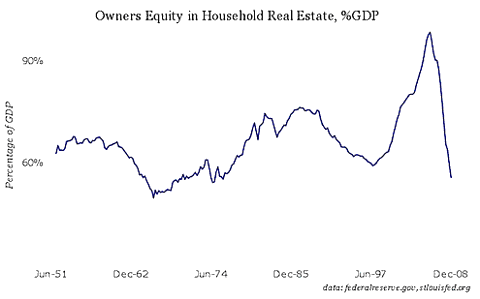
Tuesday, January 06, 2009

Key Trends for '09: Inflation & Food

plus solvency. That's critical...

"The hot trends for 2009 are:

* Inflation. Gold has started to move up. The U.S. dollar has started to move down. Overseas investors are cutting back on their purchases of dollar-denominated debt. And the faithful news consumer can see the beginnings of a tidal wave of articles and editorials worrying about the inevitability of inflation now that the Federal Reserve has decided to pay overtime to the crew that prints paper money.

* Food. Yes, food commodity stocks collapsed in 2008. And, yes, prices for food commodities went into a retreat that turned into a rout; the prices of major grains are down 50% from their 2008 peaks. But don't count on food getting cheaper still in 2009. All the signs point the other way. The United Nations' Food and Agriculture Organization has warned that because of the global credit crunch, many farmers lack capital to buy seed and fertilizer for the 2009-10 growing season. That's likely to show up in commodity prices, via the futures market, by mid-2009.

* Stability. Companies able to deliver solid revenue and earnings at or maybe even a little above expectations are rare as hens' teeth at this stage of the recession. Companies with those kinds of results are also in a position to use the current global slowdown to attack weaker competitors, buy market share and aggressively develop new products. That's a combination investors particularly prize in the current uncertainty.

I'd give those three trends green lights right now. "

http://articles.moneycentral.msn.com/Investing/JubaksJournal/10-key-trends-for-investors-in-09.aspx?page=all

I just wish I knew a good way to short treasuries.

...


"The era of procrastination, of half-measures, of soothing and baffling expedients, of delays, is coming to a close. In its place, we are entering a period of consequences." - Winston Churchill, The Gathering Storm
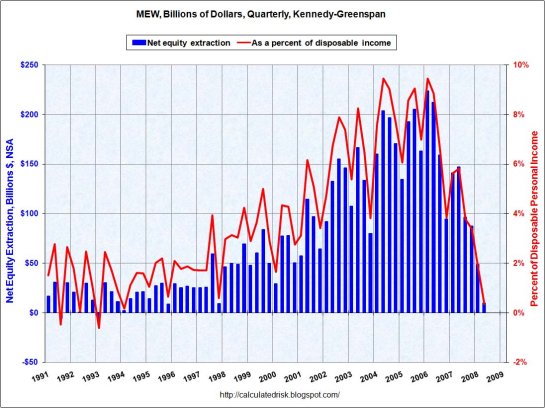
Friday, November 21, 2008

You want a bailout? Here's my offer


[sfo] Politics World
(context)
You want a bailout? Here's my offer < RuffJustice >
2008-11-21 08:04:47


If you need a taxpayer bailout, you issue us redeemable convertible preferred shares at the common price paying 1% + the 10-yr T-note rate, redeemable / convertible for 1/5 of a common share at 5x the current share price. The maximum that can be issued is of the number of common shares outstanding.


Until the preferred is redeemed:


1. The dividend paid to common and preferred stockholders must be reduced by the percentage of preferred shares issued to us divided by common shares outstanding, and


2. Executive compensation decisions will be turned over to the National Executive Compensation Board chaired by the SEC.


Don't count on a bonus.


3. If you miss a payment on our dividend, the Treasury Secretary will appoint a new CEO and board to manage the company. Don't count on a golden parachute.


reply

 blog it

Wednesday, November 19, 2008

The Gaza 2 Step

1. Kill some Israeli kids
2. Party
clipped from www.humanevents.com
On the evening of March 6 in Jerusalem, a heavily armed Palestinian terrorist from nearby east Jerusalem entered the Mercaz Harav yeshiva and opened fire on the unarmed teenage students studying there. Eight died, and 11 were badly wounded before another student and an off-duty soldier shot the terrorist. The atrocity ignited wild celebrations in Gaza.

If you thought that the celebrations were anomalous, you might want to know about recent findings just published by the Palestinian Center for Policy and Survey Research, an independent polling organization based on the West Bank. According to its polls, 84 percent of Palestinians approved of this attack. Moreover, 64 percent approve of Hamas randomly firing rockets and mortars from Gaza into Israeli communities, and 75 percent favor ending negotiations between their leaders and the Israeli government.
...so it goes.
 blog it

Monday, November 17, 2008

Meanwhile, back at the train wreck

formerly known as The Economy, the evidence of the tipping point receding in the rear view mirror continues to mount ...

"The Empire State Manufacturing Index fell to -25.4 (DE: -28.5, Consensus: -26.0) in November from -24.6 in October. The result is the lowest in the Index's brief history (it began in 2001). New orders fell sharply for the second straight month, with the index falling to -22.2 from -20.5. Shipments also fell again, dropping to -13.9 from -8.9 in October. As a result of orders falling more sharply than shipments, unfilled orders fell as well, with the index reading -24.1 from last month's -12.2. This was the 8th straight month of falling unfilled orders.

The story of this report however, was the deterioration of the employment index, which fell to -28.9 from -3.7 last month. The reading was the worst since December 2001.

The average employee workweek also dropped, with the index falling to -25.3 from -9.8. Meanwhile, expectations for employment six months from now turned negative, hitting -4.2 from 1.1 in October. Only once in the history of the series (September 2001) did the expected employment index turn negative. In 2001 however, that result was almost certainly September 11th related, as the expected index read 15.5 in August, and rebounded to 8.0 in October. This time around, it likely reflects a sharp deterioration in the economic outlook."

... In other words, it's not just getting worse, it's getting worse faster and faster. This means it's going to get REALLY BAD before it even starts to get bad more slowly. YOU'VE BEEN WARNED.

...


"The era of procrastination, of half-measures, of soothing and baffling expedients, of delays, is coming to a close. In its place, we are entering a period of consequences." - Winston Churchill, The Gathering Storm